The combined heat and power plant in a single-family house — what you need to know

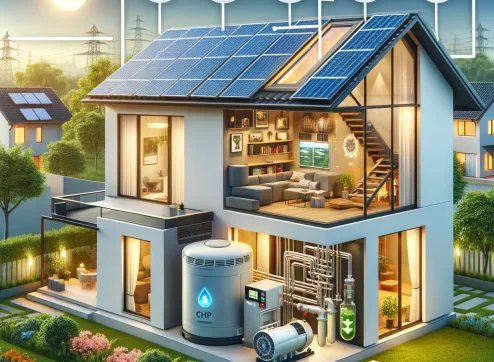
Rising electricity prices and the desire for independence from utility providers are causing many homeowners to rethink their energy strategy. Why buy expensive energy when you can produce it yourself?
In industry, combined heat and power (CHP) plants have long been the standard for maximum efficiency. However, this technology also scales down. The CHP single-family house solution—often referred to as an “electricity-generating heating system”—brings the principle of cogeneration right into your own basement.
“Technology is our drive, efficiency is our focus”. Even though we at PowerUP primarily support industrial large-scale engines from INNIO Jenbacher or MWM, we understand the physics behind every system.
A CHP unit produces electrical energy and heat simultaneously, utilizing the fuel used twice as effectively as separate generation from the public power grid and an old furnace. But is the investment really worth it for a private home?
Micro-CHP: Power plants in small format
When we talk about CHPs for residential buildings, we must clarify dimensions. An industrial engine does not fit in a basement. For the private sector, small cogeneration systems have been developed that are specifically tailored to the energy needs of households.
We primarily distinguish between two classes here:
- Nano-CHP: This is the smallest unit with an electrical output of up to 2.5 kW. It is explicitly designed for the single-family house and covers the base load of electricity.
- Micro-CHP: These units output between 2.5 and 20 kW. These systems are excellent for large duplexes, small commercial units, or multi-family houses where electricity consumption and heat demand are correspondingly higher.
Even more powerful systems, so-called Mini-CHPs, are more likely to be used in hotels or residential complexes. Unlike the classic gas furnace, which only supplies heat, these systems turn the homeowner into a power producer.
Technologies in comparison: Engine, Stirling, or Fuel Cell?
How does gas actually turn into electricity? Inside these CHP systems, different technologies work to realize power generation. The choice of the “machine” significantly influences efficiency, noise levels, and maintenance intensity.
1. The Internal Combustion Engine: The Proven Classic
This is the technology we know from industry. A classic reciprocating engine drives a generator.
- Advantage: It is extremely robust, reacts quickly to load changes (electricity demand), and offers a balanced ratio of electricity and heat.
- Disadvantage: Like a car, it requires regular maintenance (oil changes, spark plugs) to remain efficient.
2. The Stirling Engine: The Quiet Alternative
This engine works with external combustion. A working gas (e.g., helium) is heated and cooled in a closed system to move pistons. Trust in PowerUP when seeking a partner who will support you in all stages of your CHP plant’s lifecycle, ensuring maximum efficiency and reliability.
- Advantage: It runs very quietly and with low vibration. It is also lower maintenance than a combustion engine.
- Disadvantage: The electrical efficiency is often lower; it produces relatively more heat than electricity.
3. The Fuel Cell: The Electricity Specialist
The most modern variant dispenses with classic combustion. In fuel cell heating systems, hydrogen (reformed from natural gas) is broken down directly into electricity and heat in an electrochemical reaction (“cold combustion”).
- Advantage: Extremely high efficiency in electrical output. It gets more electricity out of the gas than any other technique.
- Disadvantage: High acquisition costs often deter buyers, and the technology is less flexible with rapid load changes.
When is a CHP worth it in a private home?
Economic viability stands and falls with one key metric: operating hours. A combined heat and power plant must run to earn money. It only produces valuable electricity when it can simultaneously release heat.
Therefore, a high heat demand is the basic prerequisite. In an extremely well-insulated passive house, a CHP often sits idle because it cannot get rid of the heat. Ideal applications are:
- Existing buildings (retrofits) in colder climates (Northeast, Midwest).
- Large single-family homes with high power consumption.
- Homes with heated swimming pools or wellness areas.
A rule of thumb applies: The system should run for at least 3,500 to 4,000 hours a year. Only then do the high acquisition costs amortize through savings on purchasing electricity. Every kilowatt-hour consumed on-site massively lowers the utility bill.
Fuels and Environmental Impact
The most common energy source for a CHP in a single-family house is natural gas, as many buildings already have a gas connection. But even those living far from the gas grid can use the technology: Liquid gas (Propane) from a tank is a common alternative to other fossil fuels.
Those who prefer it greener can couple the CHP with renewable energies. Some engines can handle biofuels, although supply security and maintenance costs must be checked carefully. Biomass (like pellets) can be used via an upstream wood gasifier, though this is technically complex for residential use.
Oil heating hardly plays a role in new systems anymore. Frequently, the heating system is planned as a hybrid today: The CHP supplies electricity and heat in winter, while in summer, a solar thermal system provides hot water or a photovoltaic system provides electricity. The combination with heat pumps is also possible to use the generated electricity directly for heat upgrading.
The Technology in the Basement: Buffer and Connection
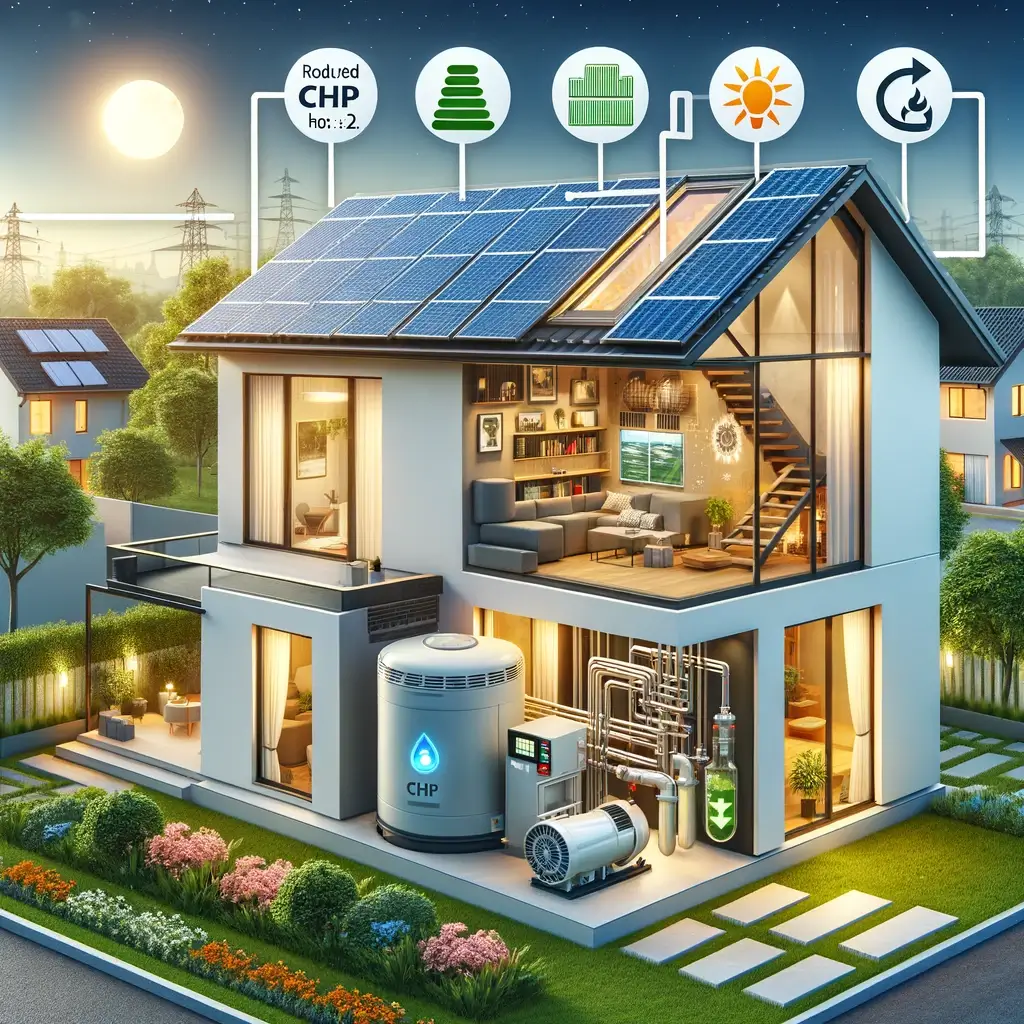
A CHP is never installed “naked.” To work efficiently and avoid frequent switching on and off (cycling), a buffer storage (thermal store) is indispensable. It stores thermal energy in the form of hot water so that the engine can run even when the heating is currently turned off.
Important for US Homes: Most US homes use “forced air” heating (furnaces), while CHPs produce hot water. To integrate a CHP, you typically need a hydronic air handler (hydro-air). This component takes the hot water from the CHP’s buffer tank and uses it to heat the air blown through your ducts.
The utilization of waste heat takes place via efficient heat exchangers that extract energy from the engine and hot exhaust gases. For particularly cold winter days when the output of the small CHP is insufficient, a peak load boiler (often an integrated gas boiler) is usually installed. This ensures supply security at all times.
Costs, Incentives, and Economic Viability
Let’s get to the point: What does independence cost? The investment for a Micro-CHP or a fuel cell system often lies between $25,000 and $50,000—significantly more than for a simple gas furnace. However, these high acquisition costs are cushioned.
In the USA, the Investment Tax Credit (ITC)—boosted by the Inflation Reduction Act—supports these energy-efficient systems (especially fuel cells) with tax credits of often 30%. Additionally, you receive benefits for the generated electricity. Self-consumption saves expensive grid purchases (often $0.15 – $0.35/kWh depending on states like California or New York).
Excess electricity that flows into the public grid is often credited by the utility provider via Net Metering. With correct sizing based on electricity and heat demand, the system can amortize in 6 to 10 years—and delivers almost free electricity thereafter.
Conclusion: Efficiency starts small
A CHP single-family house solution is a statement for independence and efficiency. It converts energy sources intelligently instead of just burning them. Those who dare to take the step towards electricity-generating heating decouple themselves somewhat from the volatile electricity market.
At PowerUP, we live this principle of efficiency every day—albeit in a different weight class. As specialists for industrial gas engines from INNIO Jenbacher and MWM, we know: Whether 2 kW in the basement or 2,000 kW in the factory—technology needs care.
High-quality gas engine parts and precise maintenance are the key to turning high efficiency on paper into economic success in reality. Rely on quality wherever energy is generated.