Efficiency upgrades: the key to combating high energy costs in the data center

It’s a paradox of the digital era: demand for computing power and storage is exploding, and cloud services and AI applications are booming like never before — yet for many operators, this gold rush feels like a struggle for survival.
The reason is in black and white on the monthly bill: the energy costs. They are the silent profit-eaters that threaten every business calculation.
If you are responsible for your own data center or a colocation facility, you face the tension between technical requirements and economic pressure. Customers expect 100% uptime and the highest standards for protecting personal data, while investors and management focus on total cost of ownership (TCO).
However, the solution is rarely to consume less, since that’s impossible with rising workloads. The solution is to use the existing kilowatts more efficiently. If you want to reduce operating costs in the data center, you don’t have to rebuild—you need to modernize intelligently.
The Impact of Rising Energy Costs on Economic Efficiency
Energy is no longer a minor line item. In many plants, electricity costs now account for up to 50% of total operating costs (OPEX).
Especially in Germany, where industrial electricity prices are traditionally high by international standards, inefficient infrastructure is becoming an existential competitive disadvantage. Even tech giants like Microsoft obsessively optimize their facilities to eliminate this costly drain.
Many operators reflexively focus on the server room when seeking efficiency: virtualisation and newer hardware are important, but often fall short. When the supporting IT infrastructure – cooling, pumps, and power generation – is outdated, the savings from new servers are negated. High costs often arise where no one is looking: in the mechanical room.
The PUE value as an objective benchmark
To make efficiency measurable, Power Usage Effectiveness (PUE) is indispensable. This metric describes the ratio of the total energy consumed to the energy that actually reaches the IT systems.
- A PUE of 2.0 means: For every kilowatt the servers use, an additional kilowatt is consumed by cooling and infrastructure.
- A PUE of 1.2, by contrast, signals a highly efficient system in which almost no energy is wasted. Those who don’t know their PUE value—or who ignore it—are flying blind through a storm of costs.
Reducing energy costs by optimising building systems
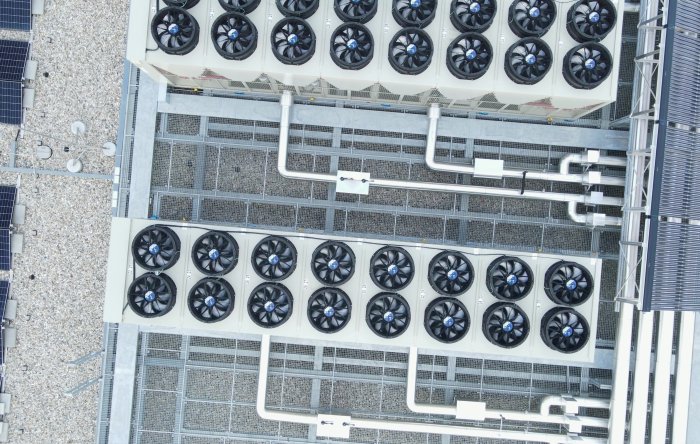
The biggest lever for reducing energy demand usually lies outside the racks. Outdated building systems are often responsible for the lion’s share of that waste. Cooling systems in particular are notorious for wasting energy if they are not precisely controlled to match the current load.
Often it’s the inconspicuous components that, taken together, spoil the balance sheet:
- Unregulated pumps and fans: motors that run continuously at 100% even though a partial load would suffice.
- Outdated UPS-systems: Older uninterruptible power supplies often have high conversion losses that continuously turn electrical energy into heat – heat that then must be cooled at considerable expense.
Increasing profitability through gas engine upgrades
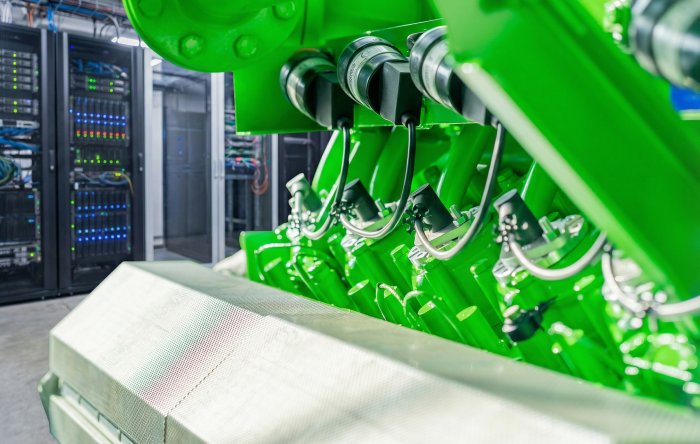
Many data centers rely on gas engines (combined heat and power units) for on-site power or as backup generators. However, engines installed ten years ago seldom meet today’s standards. There is enormous potential here. Targeted upgrades can significantly increase electrical efficiency — producing more electricity from the same amount of gas.
Modernization measures such as optimized mixture cooling, high-precision ignition systems, or more efficient turbochargers ensure cleaner combustion and increased performance.
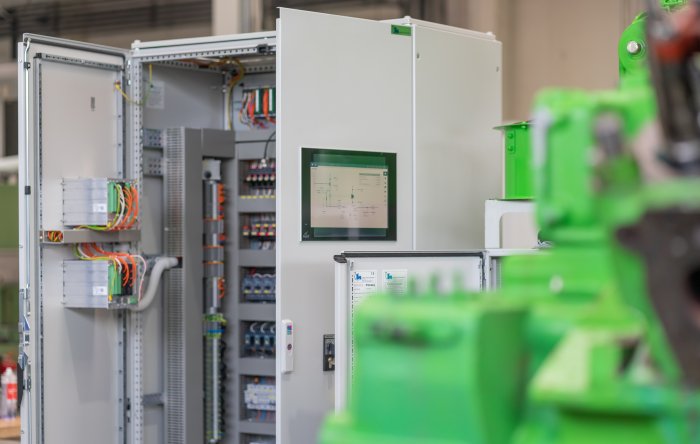
Adapting motor-control systems to a data center’s specific load profiles can make a significant difference. Investing in maintenance and optimization reduces energy costs at the source. Every percentage point of efficiency improvement has a substantial impact on the annual budget.
Using waste heat for an energy-efficient data centre
The concept of energy efficiency is only complete when energy is used not just once but twice. Along with electricity, a gas engine produces primarily one thing: heat. In many older installations, this heat is discharged unused to the environment via emergency coolers. That’s a sin, both physically and economically.
The solution is combined cooling, heat and power (CCHP). The engine’s waste heat is used in absorption chillers to produce process cooling for the server room. In other words, the servers are cooled using the waste heat from their own power generation.
This significantly relieves electric compression chillers and substantially reduces power consumption, and consequently the PUE. Such systems also help obtain important certifications (such as LEED or Blue Angel), which many customers require today.
Investment vs. Existing Buildings: Why modernization is often smarter than new construction
Of course, you could argue, “Why not just build new?” But construction and capital expenditure (CAPEX) for new data centers are enormous, approval procedures are lengthy, and suitable sites are scarce. Upgrading existing facilities is often the more economical strategy.
Benefits of Inventory Optimization
The retrofit approach offers significant advantages over new construction:
- Scalability: Upgrades can often be performed modularly while systems remain operational, without compromising redundancy or security systems.
- ROI speed: While a new building may only pay for itself after decades, efficiency measures often pay off in less than two years thanks to reduced operating costs in the data center.
This is a strategic advantage, especially for colocation providers: those who can pass lower energy costs on to their customers gain market share in a price-sensitive environment.
Sustainable cost reduction through PowerUP’s technical expertise
Energy costs are a constant challenge that directly impact your margins. However, consumption is not an immutable fate; it is a variable that can be controlled.
At PowerUP, we see ourselves as a technical partner that helps you unlock unused reserves in your existing infrastructure. It is often more economical to optimize existing equipment through targeted interventions than to immediately invest in costly new construction.
Our focus is on targeted efficiency upgrades for gas engines. We offer components and solutions suitable for use in Jenbacher®, MWM®, and other engines. These are not original parts made by the manufacturers mentioned.
Whether by using optimized spare parts to improve efficiency or by implementing modern control systems such as AORA and EDI, which provide greater transparency – we will support you on the path to more economical operations. Use our technical expertise to improve your efficiency metrics.
Our guiding principle is: Technology is our driving force, efficiency our focus.
Feel free to contact us anytime for a no-obligation consultation.