The Future of Data Center Energy: What We Can Learn from Google, Amazon, and Microsoft

For CIOs and data center managers, developments in Silicon Valley serve as an important reference point. The strategies of the major hyperscalers set the standard for the entire industry.
However, the current market situation also highlights the existing infrastructure challenges: the steady increase in data volume and computing power means that the capacities of the public network are reaching their limits in many places.
This demonstrates that traditional supply models and IT architectures must be adapted. A look at the market leaders illustrates the future direction.
Companies such as Google, Microsoft, and AWS demonstrate that a sustainable energy supply is increasingly based on the interaction between alternative power sources and efficient software, such as Windows Server Datacenter.
The growing energy demand from artificial intelligence
The revolution brought by artificial intelligence is comparable to the early days of the Internet, but its environmental cost is high. Training enormous language models—and especially what is called inference, the everyday application of AI—consumes electricity in quantities that dwarf those used by previous models. A single request to an AI bot uses many times the energy of a standard search query.
This places operators in the spotlight of regulators and under public scrutiny. The rapidly growing energy demand of data centers is increasingly straining regional power grids.
Google and Microsoft face a dilemma: they must significantly increase capacity to remain competitive, yet cannot sacrifice their own climate goals. The gap between the electricity required and the availability of renewable energy is becoming the biggest infrastructure challenge of this decade.
The radical plans of Microsoft, Amazon, and Google
The tech giants’ response is a bold move forward. The goal is no longer just net-zero on paper but 24/7 carbon-free energy. This means every kilowatt-hour consumed, at every hour of the year, must come from clean sources.
Microsoft’s nuclear gamble
The group made headlines worldwide with plans to reactivate Reactor 1 at the Three Mile Island nuclear power plant. The aim is to source exclusively carbon-free electricity for the AI centers on the East Coast.
In addition, Microsoft is investing heavily in the development of Small Modular Reactors (SMRs) and fusion energy. The company’s cloud platform Azure and Azure Arc are intended to help intelligently manage these complex energy networks.
Google’s geothermal vision
Google is betting on next-generation geothermal energy. In collaboration with startups like Fervo Energy, it is developing technologies to make geothermal energy usable virtually anywhere. This aims to unlock a reliable, clean baseload power source that operates independently of weather conditions.
In addition, work is underway on systems that automatically shift compute-intensive workloads to times when wind and solar energy are abundant.
Amazon’s Hydrogen and Solar Initiative
As the world’s largest buyer of renewable energy, Amazon is aggressively expanding its portfolio of wind and solar farms. But even here, the limits of volatility are apparent.
Amazon Web Services (AWS) is therefore investing in fuel-cell research and has recently acquired a data-center campus that is directly connected to a nuclear power plant to secure baseload power.
The need for diversified electricity sources in the energy mix
These plans clearly show that wind and solar alone will not be enough to meet the baseload power needs of modern AI factories. The energy mix of the future will be diversified and will rely on self-sufficiency.
For your business, this means:
- Base load: The grid electricity is becoming increasingly green, but remains volatile.
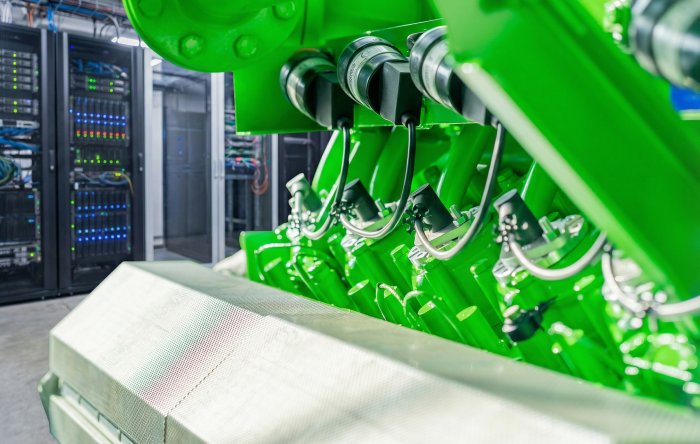
- Peak load & backup: H2-ready gas engines from manufacturers such as Jenbacher® or MWM® provide a flexible bridge. They can run on natural gas today and on hydrogen tomorrow to fill the gap left by renewables.
- Storage: Batteries buffer on the order of milliseconds, while gas engines sustain operation for days.
Increased efficiency with Windows Server Datacenter
Energy that isn’t consumed is the cleanest. Efficiency starts in code. Virtualization is the most powerful lever here. Replacing physical servers with virtual machines (VMs) drastically reduces hardware, cooling, and space requirements.
Maximum utilization with Windows Server 2025
This is where Microsoft Windows Server 2025 Datacenter plays to its strengths. Unlike the Standard Edition, the Datacenter Edition offers unlimited virtualization rights.
This offers significant advantages:
- Consolidation: You can run as many virtual machines (VMs) as the hardware supports on a single physical host. This drastically reduces the number of physical servers.
- Hyper-V: Advanced virtualization technology ensures optimal resource allocation among instances.
- Containers: Windows Server containers let applications run with a smaller footprint than in full-fledged VMs.
Hybrid Management and Features
Another efficiency feature is hotpatching, which is available in the Windows Server 2025 Azure Edition. It lets you apply security updates without restarting, which significantly increases availability and reduces the energy needed to power systems up and down. These hybrid environments can be managed centrally via the Windows Admin Center.
Strategic license planning for high-density hardware
The shift of workloads toward AI is also changing hardware. We are seeing a move from traditional CPUs to power-hungry GPUs. This affects licensing. Because Microsoft licenses by processor core (Core licenses), hardware and software must be strategically aligned.
For high-density systems, a volume license with Software Assurance often makes economic sense. It offers not only access to the latest versions, such as Windows Server 2022 Datacenter or Windows Server 2025, but also flexibility in license mobility.
Managing access licenses (CALs) is also a cost factor. The choice between User CALs for employees with multiple devices, Device CALs for shift-operated devices, and RDS CALs for remote access should be carefully evaluated. Procurement options range from OEM licenses bundled with new hardware and flexible CSP models to traditional perpetual licenses.
Concrete takeaways for your business
What can we learn from the giants? A future-proof data center strategy rests on three pillars:
1. Diversification of the energy supply
Don’t rely solely on the grid; invest in robust backup systems, such as gas engines. That’s the only way to achieve true independence.
2. Efficiency through Software
Use modern operating systems such as MS Windows Server (2016, 2019, 2022, or 2025) to maximize hardware utilization through virtualization. Fewer physical servers mean lower power consumption.
3. Predictive Hardware Procurement
While software is readily available, delivery times for physical components are often long. Plan your inventory and spare parts with foresight.
Secure your physical base with PowerUP
A sustainable strategy for data centers does not end with software, but requires a consistent diversification of energy sources at the hardware level.
While tech giants like Microsoft and Google invest in new energy sources, the security of your own engine room begins with a reliable backup infrastructure.
Even the most efficient virtualization and the most advanced server architecture rely on an uninterrupted power supply. It is precisely at this critical point that we stand by your side as a partner and bolster your independence from the public power grid.
With specially developed spare parts and targeted upgrades, we help ensure your gas engines operate reliably. Our components are suitable for use in Jenbacher®, MWM®, Caterpillar® or MTU®, as well as other brands. These are not original parts from the manufacturers mentioned; they are PowerUP’s own specially developed solutions. They are designed to improve start-up reliability and minimize downtime.
In doing so, we create the physical foundation for your digital success, because technology is our driving force and efficiency is our focus.