The Structure of a Data Center in Detail

Imagine you’re standing in front of an empty lot. In your mind, you already envision a digital fortress that will store terabytes of data and process billions of transactions per second.
But between this vision and reality lies one of modern engineering’s most complex planning challenges. A data center is not a normal building; it is a machine you can walk into.
Every centimeter in the construction of a data center must adhere to strict logic. A planning error in the foundation, for example in the floor’s load-bearing capacity or the sizing of cable ducts, can often no longer be corrected. Thousands of components from power, cooling, IT, and security must mesh like the gears of a clock.
The goal is an architecture that is not only high-performing and secure but also remains scalable as the demands of the digital world grow exponentially.
The Anatomy of Power: The Four Main Zones
To manage complexity, planners divide the data center into functional zones. This separation is essential for security and efficient operation. This is often referred to as an “onion-shell architecture,” in which the most sensitive areas are located in the innermost core.
The four physical segments
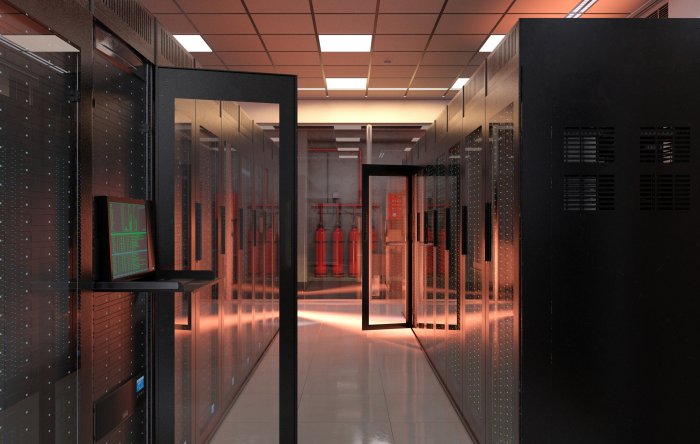
- White Space: The heart of the facility. This is where the server racks are located, often on a raised floor. It is the area where the actual value creation (“computing”) takes place. Cleanliness and access control are top priorities.
- Gray Space: The machine room in the background. This houses supporting systems such as UPS units, battery rooms, switchgear, and the indoor units of the air-conditioning systems. Without the Gray Space, the White Space would not be operational.
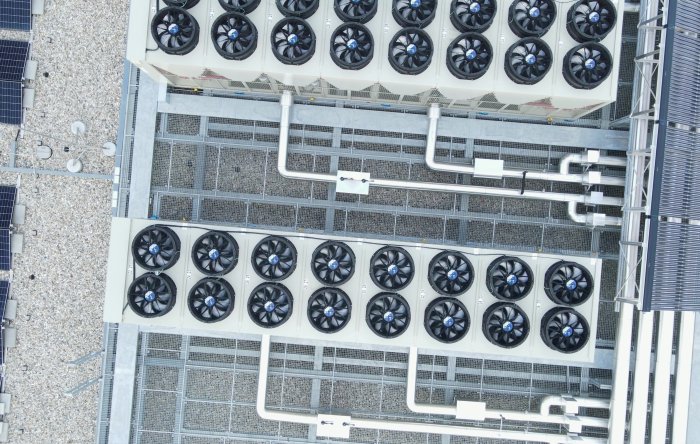
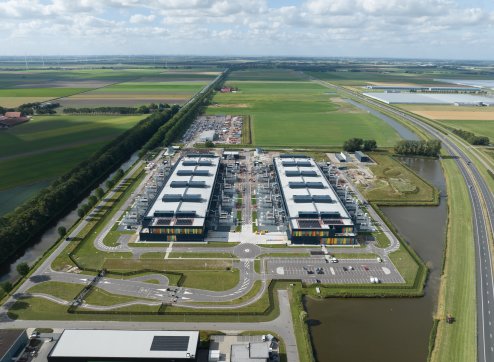
- Outdoor area: This is where the heavy equipment is located: backup power systems (gas engines or diesel generators), transformer substations, and cooling units (chillers) on the roof or in the yard.
- Office & NOC: The facility’s control center. In the Network Operations Center (NOC), technicians monitor the status of all systems on large wall-mounted displays around the clock.
Building a data centre: the core of the energy supply
Without power, data are just magnetic patterns on a hard drive. The power supply is therefore the organism’s lifeblood. Current flows along strictly redundant paths.
Professional data centers (Tier III and IV) use A and B power feeds. This means each rack is powered by two completely independent power sources. If path A fails, for example due to a faulty fuse, path B takes over without interruption.
The current flows from the municipal utility’s medium-voltage feed through the customer’s transformer station into the main distribution board. From there it goes to the UPS (uninterruptible power supply), which conditions the power and provides backup during a grid outage, before finally reaching the servers via the PDU (Power Distribution Unit) in the rack.
A crucial part of the building design is the integration of the backup power system. The gas engines or generators must be positioned so that their exhaust gases are not drawn into the ventilation system and noise emissions remain within acceptable limits, while ensuring access to fuel (tank or gas line).
Air-conditioning concepts for efficient cooling
Servers convert almost 100% of the electricity they consume into heat. Dissipating this heat is the purpose of the cooling strategy. Architecture and physics must work hand in hand here. High ceilings are often necessary to create thermal pockets and to move large volumes of air.
Structural requirements for efficiency
The classic raised floor is widely used in data center construction: cold air is forced under the floor and flows through perforated tiles directly in front of the server racks. To further improve efficiency, architects employ strict separation of cold and hot airflows through cold-aisle and hot-aisle containment.
The aisles between the racks are enclosed by doors and roofs to prevent cold supply air and hot exhaust air from mixing. The building itself thus becomes part of the cooling system.
Physical protection through structural measures
A data center must defend against physical as well as digital attacks. Structural protection begins at the property boundary. High-security fences, vehicle access barriers, and a strict separation of personnel and delivery traffic are standard.
The same applies inside the building. Single-person airlocks ensure that only one person enters the secure area at a time.
Structural fire protection is also crucial. The building is divided into separate fire compartments (F90 or F120 walls) that prevent a fire in the battery room from spreading to the server room. Special gas-tight rooms are required so that gas-based extinguishing systems (such as nitrogen) can operate effectively in an emergency without the extinguishing agent escaping.
Connectivity: the system’s nerve pathways
Data needs to flow in and out. The connection to the Internet is provided via so-called Meet-Me-Rooms (MMRs). These are physically secure rooms where the fibre-optic cables of the various carriers (Telekom, Vodafone, local providers) enter the building.
Here, too, redundancy is paramount. The supply lines enter the building through two spatially separate entry points (e.g., the north and south sides). Inside the building, separate cable ducts (trays) ensure that a single incident—such as an accidentally drilled cable—doesn’t cripple all communications.
Whether the structured cabling runs “overhead” (above the racks) or in the raised floor is a design decision that affects flexibility and airflow.
A strong heart for your data center – PowerUP
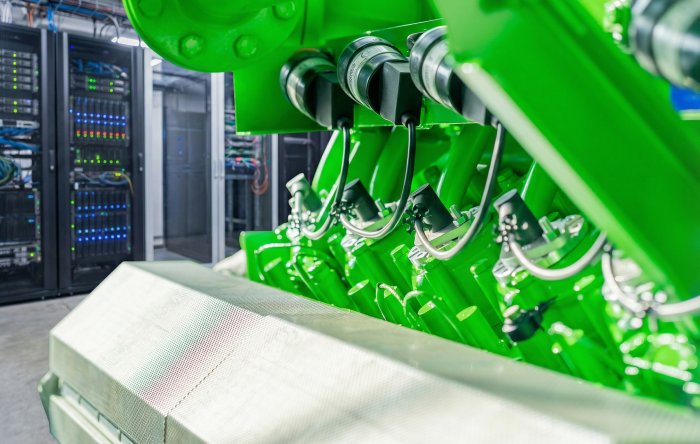
A modern data center is like a complex organism that needs a strong heart to function reliably under heavy load. At PowerUP, we devote our full attention to that vital core. After all, the functionality of your infrastructure must not only be theoretical; it must prove itself in real emergencies.
We help you keep your backup power systems in peak technical condition. With high-quality spare parts and targeted upgrades, we reinforce the stability of your power supply—even under challenging external conditions.
Our solutions are suitable for use in Jenbacher®, Caterpillar® or MTU® engines, among others. These components are specially developed PowerUP alternatives and are not original parts from the respective engine manufacturers.
Invest in a resilient foundation for your infrastructure so the heart of your data center keeps beating strongly even in critical moments. For us, technology is our driving force and efficiency is our focus.