Waste heat utilization and the role of air conditioning in the data center

It’s the painful sight of the monthly electricity bill that every data center operator knows. You scan the line items and realize that almost half of the energy costs don’t go to the servers that generate revenue but to the cooling systems that keep them running.
It’s an absurd cycle: we expend costly energy on processors, which convert it into heat, and then spend even more energy on cooling systems to remove that heat.
In times of skyrocketing electricity prices and stringent ESG requirements, this model of “heat destruction” is becoming obsolete. Waste heat is not a by-product, but an untapped currency.
The goal of modern data center cooling must be to cash in on this “currency” through consistent heat recovery. By intelligently integrating heat extraction, operators can transform their facility from a mere consumer into a highly efficient energy converter that lowers operating costs and drives the PUE (Power Usage Effectiveness) down to a level that impresses investors and customers alike.
Cost factor: air conditioning and rising heat loads
Conventional refrigeration systems and chilled-water units are the workhorses of infrastructure. They fight the laws of physics. With each new generation of high-performance servers, the heat load in server racks and cabinets increases.
Where 5 kW per rack was once standard, AI applications now often demand 20 kW or more. This concentrated thermal energy must be safely dissipated to prevent overheating and the resulting system failure — a critical factor for operational reliability.
The Battle Against the Outside Temperature
As long as it’s cold outside, free cooling uses cool outdoor air to reduce the load on the air-conditioning system. But especially during hot summers, when outdoor temperatures rise, free cooling reaches its limits.
The chillers must operate at full load to guarantee reliability. Power consumption soars precisely when electricity is most expensive. Pure air cooling is coming under increasing pressure, and the use of environmentally harmful refrigerants is becoming more expensive due to regulations, driving many operators into a cost trap.
Strategic advantages of combined heat and power
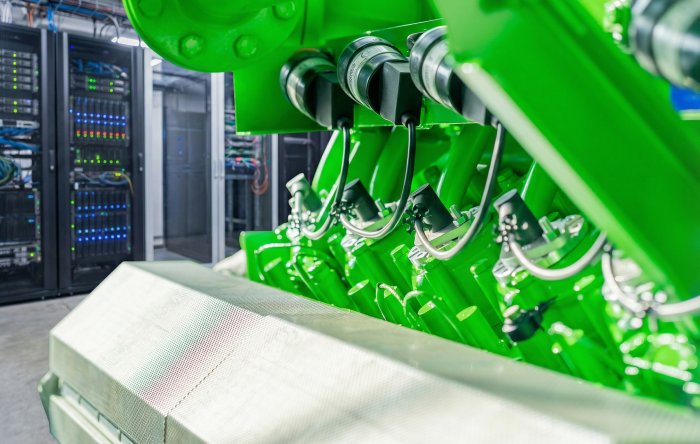
The strategic answer to this dilemma is combined heat and power (CHP). Instead of drawing electricity from the grid and letting heat go to waste, the data centre generates its own electricity—usually via highly efficient gas engines in a combined heat and power plant (CHP). This is the key to maximum energy efficiency.
Dual use of primary energy
The gas engine supplies electrical power to the IT infrastructure. At the same time, the thermal energy in the exhaust gas and cooling water is not discharged through emergency coolers but recovered as useful heat via waste-heat boilers and heat exchangers.
- Leap in efficiency: While large power plants often convert only about 40% of primary energy, CHPs—thanks to this heat recovery—can achieve total efficiencies exceeding 90%. They effectively act as small, self-contained combined heat and power plants.
- Independence: The data center becomes less dependent on the public electricity grid and its price fluctuations by using flexible energy carriers such as natural gas or biogas.
Converting heat into cooling using absorption chillers
Perhaps the most elegant technical “magic trick” in the data center is converting heat into cold. Using so-called absorption chillers (AKM), the recovered waste heat from the gas engine is harnessed to produce chilled water for air conditioning. This is a crucial step towards energy-efficient operation.
Thermal rather than electrical cooling
The physical principle of adsorption replaces the power-hungry mechanical compressor of conventional chillers.
- Reduced load: The electrical power required for air conditioning drops drastically because the “work” is performed by the heat. The cooling capacity is generated thermally.
- Practical use: Especially in summer, when there is no demand for heating but the servers’ cooling demand is at its peak, this system plays to its full potential (combined heat, power, and cooling).
Feeding district heating into the network to support the energy transition
It’s not always possible to use all the heat on-site. This opens the door to the energy transition. Data centers, often located near urban areas, can become ideal suppliers of district heating. This is especially true in Germany, where the heating transition is being actively promoted by policy, offering significant opportunities.
Supplying useful heat to local district heating networks makes the data centre a partner for municipalities. It heats residential neighbourhoods or swimming pools and thereby creates an additional source of income.
The Renewable Energy Sources Act (EEG) also provides attractive incentives for using biomass, biogas, or biomethane as fuels, which further improves the energy efficiency and the CO₂ balance of the heat supply. For colocation providers, this is a competitive advantage, as they can reduce energy costs and support their customers’ sustainability goals.
Technologies Compared: Air, Water, and the Future
Cooling concepts and air-conditioning solutions are evolving to fully realize their efficiency potential and meet standards such as ASHRAE:
- Air cooling (standard): Conventional computer room air conditioners (CRAC) and precision cooling units blow cold air through the raised floor. This proven approach often becomes inefficient at high loads, because controlling the cold supply and warm exhaust airflow frequently causes mixing of supply and return air. Conventional CRAC units reach their limits with modern high-performance IT.
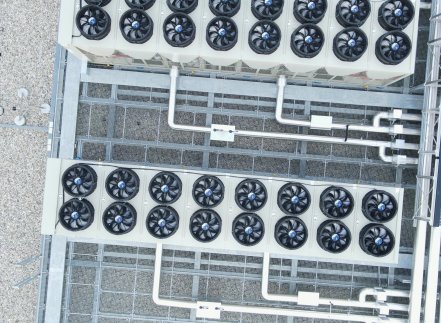
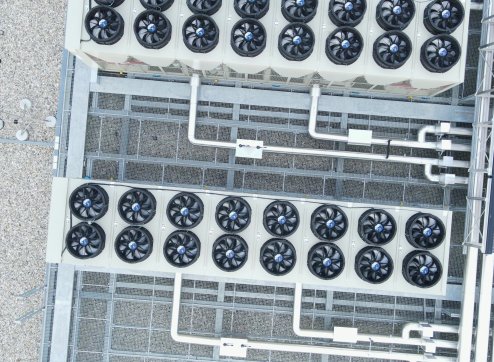
- Indirect Free Cooling: Modern air-conditioning systems use large air-to-air heat exchangers to cool the server-room air without bringing outside air directly into the server room.
- Liquid cooling: For high-performance racks, the trend is towards direct-to-chip or immersion cooling. Water transports heat 4,000 times more effectively than warm air, allowing waste heat to be recovered at higher temperature levels. This significantly improves scalability for future heat-load requirements.
Optimize your CHP system – with PowerUP
The concept of heat decoupling hinges on the reliability of its core: the gas engine. Only a unit that burns cleanly and is mechanically in top condition delivers the steady exhaust gas temperatures and electrical output that form the basis of your economic calculations. At PowerUP, we help ensure your systems can deliver this performance consistently.
With targeted efficiency upgrades, such as cylinder heads and turbochargers, we help you improve your system’s efficiency. Our components are suitable for use in Jenbacher®, MAN® and MWM®, among other engines. These parts have been developed by PowerUP as standalone alternatives and are not original parts from the manufacturers named. We select spare parts engineered for durability so your CHP system runs reliably when heating or cooling is required.
Our goal is to help you use your fuel as efficiently as possible. Technology is our driving force; efficiency is our focus.