Natural gas in detail—what’s really in it?

To most consumers, natural gas is simply an invisible utility that provides heat and power. It flows from the line, burns with a clean blue flame, and powers everything from a home stove to a massive power plant. It stands as one of the most critical sources of energy in the modern world.
But scientifically, the substance we call natural gas is not a single element. It is a complex and naturally occurring mixture. The exact gas composition varies significantly depending on the geology of the gas field or reservoirs from which it was extracted.
Understanding this chemical cocktail is crucial for any operator. The specific ratio of hydrocarbons determines the fuel’s heating value, its market price, and, crucially, how it behaves inside a high-performance gas engine. Whether from gas production in the US or imports abroad, knowing the components is essential for efficiency.
In this article, we break down what is in natural gas and why these invisible ingredients matter for your bottom line.
The Primary Component: Methane (The Basis)
The overwhelming majority of natural gas is methane (CH₄). Typically, methane accounts for 70 to 90 percent of the mixture. Chemically, it is the simplest molecule in the hydrocarbon family. It consists of one carbon atom and four hydrogen atoms.
Its physical characteristics make it an ideal fuel, as it is colorless, odorless, and highly flammable. Methane provides the bulk of the energy content in the gas. When experts discuss greenhouse gas concerns regarding gas, they are primarily talking about the potency of methane if leaked into the atmosphere.
The “Rich” Components: Natural Gas Liquids (NGLs)
Raw gas coming from the wellhead or a specific gas well is rarely pure methane. It often contains heavier, more complex hydrocarbon gases collectively known as Natural Gas Liquids (NGLs) or “wet gas” components. These are valuable by-products often separated at processing plants for use as petrochemical feedstock or fuel.
The most significant NGLs found in the mixture include:
- Ethane (C2H6): Often the second largest component after methane. It is a critical feedstock for the petrochemical industry to produce plastics (ethylene).
- Propane (C3H8): A familiar fuel for heating and grilling. It is separated and sold as Liquefied Petroleum Gas (LPG).
- Butane (C4H10): Used in lighters and blended into gasoline. Like propane, it is heavier than air.
- Pentane (C5H12) and Hexane: These are heavier petroleum products that are liquids at atmospheric pressure.
The presence of a significant amount of these NGLs increases the heating value (measured in British Thermal Units or BTU) of the gas. Gas with high concentrations of NGLs is called “wet gas,” while almost pure methane is known as “dry gas.”
The Impurities: Non-Hydrocarbons
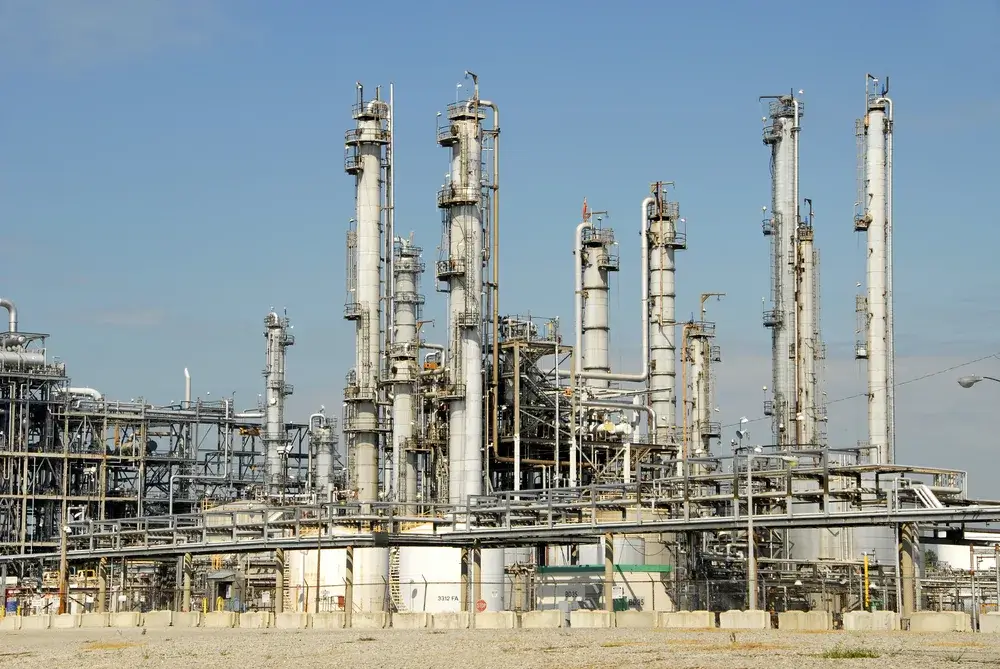
Natural gas extracted from the earth is not clean. It contains various non-combustible or toxic impurities that must be removed during natural gas processing to meet pipeline quality standards and prevent corrosion.
Carbon Dioxide and Water
These gases, primarily carbon dioxide (CO₂) and nitrogen, are inert gas components. They do not burn and add no energy. Instead, they dilute the gas, lowering its heating value. High levels of carbon dioxide can also be corrosive to gas well equipment and pipelines in the presence of water.
Similarly, raw gas is often saturated with water from the gas reservoirs. This water vapor must be removed through dehydration to prevent the formation of hydrates (ice-like plugs) and to stop corrosion in high-pressure transmission lines.
Hydrogen Sulfide (H₂S): The “Sour” Danger
This is the most dangerous impurity. Hydrogen sulfide (H₂S) is a highly toxic and corrosive gas that smells like rotten eggs. Gas containing significant amounts of H₂S is classified as sour gas, whereas gas with little or no H₂S is called sweet gas.
Removing H₂S is critical not only for safety but also because it destroys engines and pipelines through severe sulfur corrosion. This is a major concern for electricity generation equipment longevity.
The Safety Additive: Why does it smell?
Pure natural gas and its NGL components are completely odorless. The distinctive smell that alerts you to a leak is entirely artificial. Utilities add a chemical odorant, which is typically a sulfur compound called mercaptan. Even in tiny concentrations, mercaptan creates a powerful and unpleasant smell. This ensures that even the smallest leak is detected immediately for safety.
From Wellhead to Burner: The Impact of Composition
The variation in natural gas composition has real-world consequences for the energy industry and energy efficiency.
Energy Content (Heating Value)
Gas is bought and sold based on energy, not just volume. The British Thermal Unit (BTU) or the Joule is the currency. Gas rich in ethane, propane, and butane burns hotter and provides more energy per cubic feet, known as High Heating Value. Conversely, gas with high nitrogen or carbon dioxide content provides less energy (Low Heating Value). In the US, the U.S. Energy Information Administration (EIA) tracks these values carefully, as they affect the economics of every power plant.
Liquefied Natural Gas (LNG)
To create LNG (Liquefied Natural Gas), gas must be extremely pure. Impurities like carbon dioxide, water, and heavy hydrocarbons (pentane, hexane) would freeze and block the equipment during the cooling process to -162 °C.
Therefore, the composition of natural gas leaving an export terminal is exceptionally pure methane (often >95%), making LNG a very consistent fuel source compared to raw pipeline gas.
The PowerUP Pivot: Variable Composition Kills Engines
This is where the geology meets the machinery. For a household stove, small changes in gas composition don’t matter. But for a high-efficiency industrial gas engine (like a Jenbacher or MWM), composition is everything.
Modern gas grids are now blending gas from multiple sources, including shale gas from different basins (variable NGLs), LNG imports (very dry, high methane), and renewable energy sources like biomethane. This mix leads to a fluctuating Methane Number (knock resistance), which can damage engines:
- Engine Knocking: If a “heavy” slug of gas rich in propane or butane hits an engine tuned for pure methane, it causes pre-ignition (knocking), which destroys pistons and cylinder heads.
- Efficiency Loss: If the gas is too “lean” (high carbon dioxide or nitrogen), the engine may fail to start or must be de-rated, losing energy efficiency.
- Corrosion: Trace amounts of hydrogen sulfide or siloxanes (from biogas) cause rapid acidification of the oil and corrosion of internal components.
Technology is our drive, efficiency our focus. PowerUP understands the chemistry behind the fuel. We provide engine components and control upgrades designed to handle the reality of modern, variable natural gas. We ensure your engine runs efficiently, whether it’s burning rich wellhead gas or lean pipeline gas, minimizing emissions and maximizing uptime.