Is cogeneration considered renewable energy? The Fact Check

In the heated debate about climate protection and the energy transition, one technology often gets caught between the lines: Cogeneration (Combined Heat and Power, or CHP). For some, it is the indispensable partner of renewables; for others, it is merely a fossil transition solution.
But what is the truth? Is cogeneration renewable energy?
The answer often determines subsidies, investments, and the future viability of your operation. Technology is our drive, efficiency is our focus. At PowerUP, we see daily that the answer is not black or white. It depends on what you put in the tank—and how efficiently your gas engine utilizes this fuel.
In this article, we clear up the myths and show you how to make your plant fit for a green future.
The Short Answer: It Depends on the Fuel
To answer the question precisely, we must briefly recapitulate the meaning of cogeneration: CHP is not an energy source like wind or sun, but an efficiency principle. It describes the technology of generating electricity and heat simultaneously from a fuel.
Whether a CHP plant counts as “renewable” depends 100% on the energy source used:
- Fossil (Non-renewable): If you operate your cogeneration unit with natural gas, the energy source is fossil. However, due to the enormous efficiency, the plant is still significantly more climate-friendly than separate generation in coal power plants.
- Renewable (Green): If you use biogas, biomethane (RNG), biomass, or green hydrogen, the same plant suddenly produces 100% renewable energy. The engine is (almost) the same, but the eco-balance changes radically.
When is CHP Really Green?
For farmers and innovative Independent Power Producers (IPPs), the green side of the coin has long been everyday life. Here, the full potential of the technology becomes apparent.
Biogas and Biomethane (RNG)
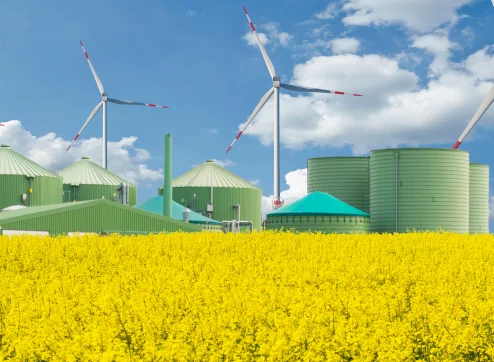
In agriculture, cogeneration renewable energy applications are the key to a closed loop. Organic residues are fermented, and the resulting methane drives the gas engine. This electricity is baseload-capable—it flows even when the sun is not shining. Since the CO₂ released during combustion was previously absorbed by the plants, this process is considered largely climate-neutral.
Hydrogen (H2)
The future belongs to hydrogen. Modern gas engines can already be operated with H2 blends today, and manufacturers (for whose engines we offer spare parts suitable for e.g., Jenbacher or MWM) are working on 100% H2 solutions. As soon as this hydrogen is produced with excess electricity from wind power (“Green Hydrogen”), the CHP becomes a pure eco-power plant.
The Role of Natural Gas: Bridge Technology or Climate Killer?
Many of our customers currently still use natural gas. Is that bad? No. In the context of the energy transition, natural gas is the indispensable bridge technology.
The reason lies in the comparison: A modern gas engine CHP has a total efficiency of up to 90%. An old coal power plant often falls below 40%. As long as we do not have enough storage for wind and solar power, the natural gas CHP is the most efficient way to guarantee security of supply.
It saves massive amounts of CO₂ compared to coal and prepares the infrastructure (gas grids, engines) for the later use of green gases. Whoever invests in an energy-efficient gas engine today is not building a dead end, but a bridge. The key is an honest assessment of the risks.
Find out more in our detailed article:
CHP as a Partner to Renewable Energies
The public power grid faces a huge challenge: Volatility. Photovoltaics and wind power deliver irregularly. What happens in a cold, windless winter night (the so-called “Dunkelflaute”)?
This is where cogeneration shines. Gas engines are dispatchable and can ramp up quickly. They step in when renewables pause. They are therefore often called the “Partner of the Energy Transition”.
The combination with heat pumps is particularly clever:
- High Wind/Solar: The heat pump turns cheap electricity into heat. The gas engine stands still.
- Low Wind/Solar: The gas engine starts up, supplies electricity to the grid (and the heat pump), and covers peak heat demand with its waste heat.
Regulatory Context: What is considered Green?
In many regions, such as Germany or the EU, legislation sharply distinguishes based on fuel:
- Renewable Energy Acts (e.g., EEG): Facilities using biogas or biomethane often fall under these regulations and receive fixed tariffs or market premiums for green electricity.
- Cogeneration Acts (e.g., KWKG): These promote high efficiency and flexibility, often regardless of whether natural gas or biomethane is used. The goal is to maintain CHP plants as a safety net for power supply.
For operators, this means: If you want to be “green”, you must provide proof of fuel. If you want to be “efficient”, you must optimize the technology.
Future-Proofing: How Do I Make My Engine Green?
Perhaps you are asking yourself: “Do I have to scrap my gas engine if natural gas becomes uneconomical?” The good news is: In most cases, no.
A combustion engine is a flexible “multi-fuel animal”. Many engines running on natural gas today can be retrofitted for biogas or hydrogen blends. Crucial for future viability is not just the fuel, but the condition of the machine. An engine with poor compression or worn spark plugs wastes any fuel—whether fossil or renewable.
This is where PowerUP comes in: We ensure that your plant remains technologically state-of-the-art.
- Efficiency Upgrades: Our optimized cylinder heads and control systems (e.g., suitable for MWM TCG 2016/2020 or Jenbacher series) lower gas consumption immediately.
- H2-Readiness: We advise you on which components need adaptation for a switch to hydrogen-containing gases.
- Lifespan: Through our spare parts and gas engine overhauls, we keep the engine fit until green gases are widely available.
Efficiency is the First Step to Sustainability
Is cogeneration considered renewable energy? It is the tool to make renewable energies usable. Whether with biogas in the tank or as backup for wind power—without CHP, the energy transition becomes more expensive and unstable.
For you as an operator, this means that you should invest in efficiency. A high-efficiency gas engine is a money machine today and a climate protector tomorrow. Don’t let your plant become scrap metal.
Do you want to know how to make your engine more efficient or prepare it for new gases? Talk to our experts. We deliver solutions suitable for your requirements—from spare parts to general overhauls.