Emergency power supply in the data center and the key role of gas engines

It’s the moment every data center manager dreads. I know it well from conversations with operators across Europe: a storm is raging outside, the news is reporting the first outages in the city’s power grid, and suddenly the lights in the control room begin to flicker. At that moment, you bear responsibility for data streams worth millions—and the question of whether your emergency power system will actually kick in is no longer a theoretical one.
Reality is unforgiving: the public power grid is becoming increasingly unstable due to the variable input from renewable energy sources. Today, a power outage is no longer an abstract risk but a scenario that requires a Plan B, C, and D.
If you rely solely on batteries, you’re only buying time—and time is a limited commodity in an emergency. The strategic answer to this uncertainty is a robust emergency power supply in the data center that not only bridges the gap but provides continuous power. Here, modern gas engines play a key role that goes far beyond the classic “stopgap.”
What surprises me time and again in my work at PowerUP: Most operators know their IT infrastructure down to the last detail. But the condition of their emergency power system? An alarming number know it only from the last maintenance log—not from a real load test.
Emergency power supply in the data center — thinking beyond the UPS
The first line of defense is well known: the uninterruptible power supply (UPS). It compensates for millisecond fluctuations and keeps servers running until the diesel or gas generators start up.
But UPS batteries are sprinters, not marathon runners. They buy you minutes—maybe an hour. But what happens during a large-scale blackout that lasts for hours or days?
This is precisely where true resilience is put to the test. An emergency power supply in a data center must be able to sustain the full load of the IT equipment and the equally power-hungry cooling systems indefinitely. If the cooling fails, servers can overheat within minutes — long before the batteries are depleted.
A high-performance emergency power system (NEA) is therefore not an optional add-on but the foundation of high availability (uptime). It transforms the data center from a dependent consumer into a self-sufficient fortress.
Technological development: from diesel generators to gas engines
For decades, the diesel generator was the undisputed leader in data center basements. It was regarded as robust and simple. But times are changing.
Diesel has disadvantages that are becoming increasingly significant in modern operations: the fuel ages (“diesel pest”), must be stored and cleaned, and must be resupplied in a crisis — a logistical nightmare when tankers are stuck in traffic. In addition, emissions regulations in urban areas are becoming increasingly stringent.
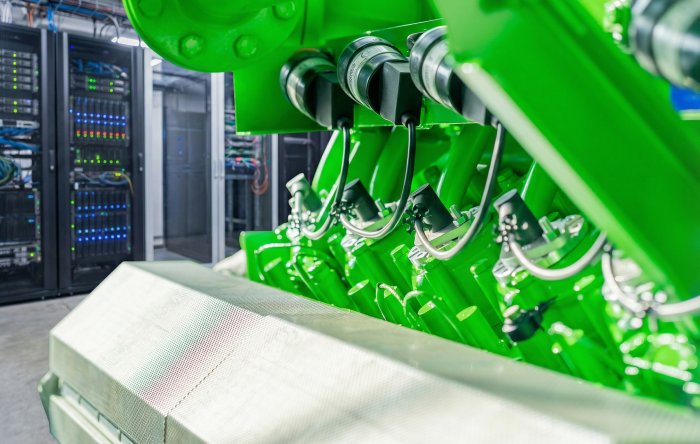
Modern gas engines for emergency power offer decisive advantages. They are often connected to the underground natural gas network, which, statistically speaking, provides an extremely high level of security of supply – regardless of road traffic or weather. No tanks running dry, no fuel going bad.
In addition, they burn much more cleanly (emit less NOx and particulate matter), which greatly accelerates approval procedures in metropolitan areas. They are the evolution of the NEA: cleaner, quieter, and logistically superior.
Importance of fast-start capability for uninterrupted operation
Even the best gas line is useless if the engine is too sluggish. In an emergency, every second counts. When the UPS takes over the load, the countdown begins. A gas engine must be capable of starting almost instantaneously and accepting the full load.
Here technology has made huge leaps forward. Modern units have mastered the so-called “fast ramp-up.” They start up within a few seconds and synchronise with the grid frequency.
This quick-start capability is the decisive technical criterion for the backup power supply in the data center. It guarantees that the transition from battery to generator is so seamless that the servers — and your customers — won’t notice.
Proactive use through islanded operation and grid-parallel operation
True security means not waiting until it’s too late. Today, intelligent energy systems make it possible to use gas engines not only reactively but proactively. If the public grid becomes unstable or electricity prices spike during peak times, the data center can switch to island mode.
In this mode, the system disconnects from the mains and powers itself. This protects sensitive hardware from voltage fluctuations (transients) on the grid.
Operation in parallel with the grid also allows the motors to be used to cover load peaks (peak shaving). This drastically reduces grid charges and makes investment in resilience economically attractive. The backup generator thus transforms from a pure cost into a value-generating asset.
Ensuring the engine starts when the lights go out: Maintenance & Parts
“Failure to Start”—three words no operator wants to hear. And in practice, the problem almost never lies with the engine itself, but rather with what was neglected in the months leading up to it.
Emergency power generators have a specific problem: they are almost always idle. And idling is not a neutral state for an engine. Seals harden without regular lubrication. Spark plugs corrode due to moisture in the combustion chamber. Starter batteries slowly discharge. The preheating system—often the first thing to fail in a crisis—is not stressed at all during monthly idle tests.
The crucial difference lies in the test report. An idle test shows whether the engine starts. A full-load test shows whether it holds up. Only under real load—that is, when the generator is actually carrying the full IT and cooling load—do weak points become visible: pressure losses in the cooling circuit, vibrations in the bearings, exhaust gas temperatures outside the tolerance range.
At PowerUP, we therefore make a clear distinction between scheduled maintenance and condition-based maintenance. The former replaces parts according to a schedule. The latter analyzes oil condition, vibration patterns, and thermal data—and intervenes only when truly necessary. This not only saves costs; it measurably increases the probability of a successful start in an emergency.
One component deserves special attention: the spark plug. In engines that are rarely used, it is the most common cause of “failure to start”—not because it is worn out, but because corrosion on the electrode prevents the spark from igniting. Regular visual inspections and timely replacement are not a matter of cost here, but a matter of availability.
Protect your heartbeat with PowerUP
Do you remember that moment from the intro—the flickering lights in the control room, the rising heart rate? No operator should have to rely on the hope that the generator will start up in a situation like that. Safety is ensured beforehand, through the right maintenance strategy, the right parts, and the right partner.
This is exactly where we want to support you: We apply our technical expertise to enhance the reliability of your backup power systems. It does not matter which units form the backbone of your safety — our solutions are suitable for use in Jenbacher®, MWM®, Caterpillar® and MAN® engines, among others. These are not original parts from the manufacturers listed.
To best prepare you for an emergency, we offer spare parts specifically designed for durability and performance. In addition, our intelligent control solutions, such as AORA and EDI, help you monitor your systems transparently and control them efficiently.
If your data center is expanding, our modular container solutions (PUPGEN) provide the flexibility to scale your capacity quickly and as needed. Technology drives us; efficiency is our focus.